From dossier to clinical trial · what a dossier makes possible

A dossier doesn't stop at synthesis. A team can carry one of its hypotheses all the way to a clinical trial design.

Every dossier hands your team 13+ pre-powered, falsifiable hypotheses on a base of hundreds of verified sources. That base is what lets a team take one hypothesis — using public data and simulation, no wet lab — to a trial-design-grade, pre-IND-ready design. To show what's possible, we did it ourselves on the fibrosis dossier. The full worked example is below.

The dossier is the base. Here's how far it can take you.

Every dossier hypothesis already ships as a funding-grade scaffold — a real, editable power calculation on labeled assumptions, sitting on a synthesized base of hundreds of verified sources. From that base, a single hypothesis can be matured into a trial-design-grade, pre-IND-ready design: roughly 22 linked analyses across ~19 disciplines, every number reproducible from open, seed-fixed code.

That is the middle rung between what a dossier delivers and what an IND-enabling program does — everything computable before a wet lab, and honest about the three things it deliberately does not do: produce wet-lab data, prove the human efficacy the trial exists to measure, or file an IND. To show what the base makes possible, we built the complete example below on our own fibrosis dossier.
The five moves

How a line of synthesis becomes a buildable trial.

Move 1

Ground the control arm

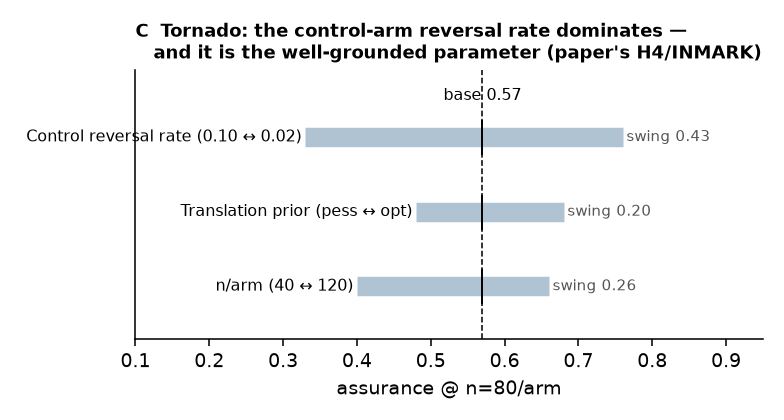
Reframe "does it work?" into "does it beat what the backbone alone does?" — then source that number from real trial evidence. It's the parameter that decides everything.

Move 2

Find the patients today's trials can't see

A biomarker-enrichment design drawn from our own pre-registered public-data analysis — the population a conventional endpoint is structurally blind to.

Move 3

Discount the effect honestly

A translation-risk prior over an unproven effect yields the trial's true probability of success — a defensible number you can take to an investment committee, not a hope.

Move 4

Simulate a design that de-risks itself

A 20,000-replication adaptive Monte-Carlo trial with true operating characteristics — power, type-I error, futility — that stops early and cheaply when the effect isn't there.

Move 5

Unlock the endpoint — the real product

The exact FDA endpoint-qualification path that makes the trial legal in the first place. Whoever qualifies the readout unlocks every program that comes after.

And around it

The full package

Causal DAG & ICH-E9(R1) estimand, QSP dose-window, in-silico safety (FDA adverse-event mining), IP/FTO scan, decision analysis, health-economics, and the assembled protocol synopsis, SAP, DSMB charter, and consent a CRO can start from.

The complete worked example · Fibrosis

One dossier hypothesis, carried to a full clinical trial design.

We took the fibrosis dossier's Hypothesis 1 — that clearing the persistent myofibroblast is the rate-limiting step for reversal — and carried it to a complete, pre-IND-ready trial design. The full document is below: a grounded control arm, the enrichment population, an honest probability of success, the adaptive design, the FDA endpoint-qualification path, and the assembled protocol.

The worked design + outcome

Fibrosis — Clinical Trial Design

The actual 15-page document: grounded control arm, biomarker-enrichment population, honest probability of success, the 20,000-replication adaptive design, the FDA endpoint-qualification path, and the assembled protocol, SAP, and DSMB charter. Trial-design-grade, not IND-filed.

Read the full design (PDF)
~5%control arm, grounded in trial evidence
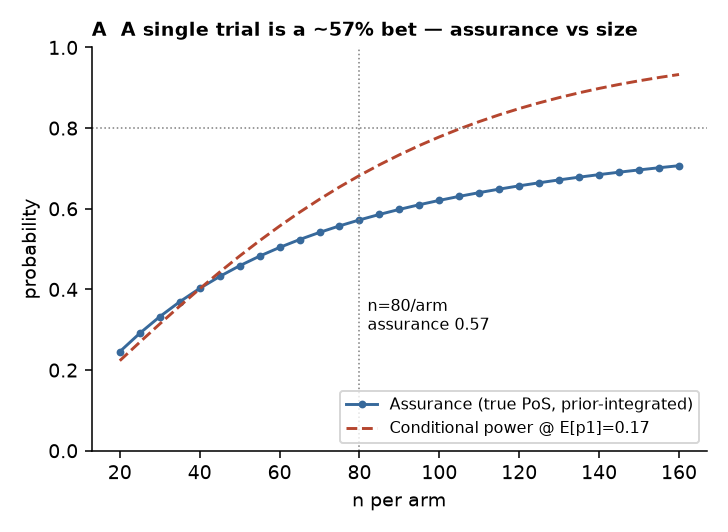
57%honest odds of a single fixed trial
82%power under the adaptive design
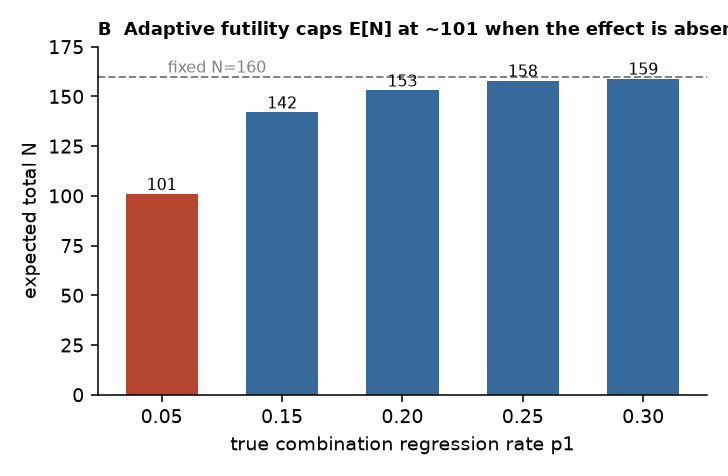
160 → ~101enrollment cut when the drug fails
Pre-registration OSF 10.17605/OSF.IO/HNWZT Preprint Zenodo 10.5281/zenodo.21248004 Every trial-design number reproduces from open code
Inside the fibrosis design

The numbers, computed — not asserted.

Four figures from the fibrosis trial design. Every one reproduces from the open, seed-fixed code in the deposit.

Assurance vs trial size — a single fixed trial is about a 57% bet
Assurance vs. trial size. A single fixed trial is about a 57% bet — the honest number most decks hide.
Adaptive futility caps expected enrollment at about 101 when the effect is absent
Adaptive futility. Expected enrollment drops from 160 to ~101 when the drug isn't working — you pay full price only when the biology pays you back.
Sensitivity tornado — the control-arm reversal rate dominates the decision
Sensitivity tornado. The decision is dominated by the control-arm reversal rate — and that is the parameter the evidence grounds best.
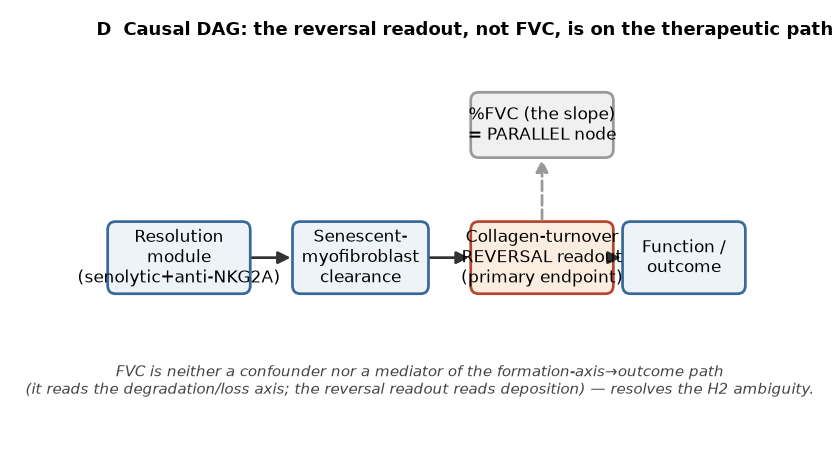
Causal DAG — the reversal readout, not FVC, is on the therapeutic path
Causal DAG. The reversal readout — not the lung-function slope — is on the therapeutic path, which is what makes the endpoint the real product.
What this is — and what it is not. Trial-design-grade, not IND-filed.

A Blueprint does not run the trial, prove the biology, or replace the toxicology, chemistry, and manufacturing an IND demands. The efficacy effect is trial-measured, and the enrichment analysis is our own pre-registered, first-party re-analysis. What you get is a decision-grade map of the exact trial the field can't yet run: which patients, which endpoint, which odds, which regulatory move, and which safety line you cross at your peril.

This is what a dossier makes possible.

Every dossier carries 13+ hypotheses built to this standard — each one a potential launchpad. Browse the catalog and start from the base.